The manufacturing industry is undergoing a huge amount of digital transformation. Technologies such as Artificial Intelligence (AI), cloud computing, robotics are helping manufacturers build smarter, faster, and more efficient production system. Among these innovations, the Digital Thread has emerged as one of the most powerful technologies for creating connected, data-driven manufacturing ecosystems.
A Digital Thread enables manufacturers to connect every stage of a product's lifecycle. This helps to create more concepts and then design to finish the production. Quality control, maintenance, and end-of-life management is also a part of this procedure. Instead of storing information in isolated systems, it creates a continuous flow of data that improves collaboration, decision-making, and operational efficiency.
What Is a Digital Thread?
A Digital Thread is a framework that connects information from first phase to last phase of a product's lifecycle. It creates a single, continuous stream of information that links people, machines, software systems, and business processes.
Traditionally, engineering, production, quality assurance, and maintenance departments worked with separate databases and disconnected information. This often led to communication gaps, duplicate work, delayed decision-making, and costly errors.
A Digital Thread removes all of these problems by ensuring the accuracy and real-time information is available to everyone who involved in the same project.
The Digital Thread typically connects:
- Product design
- Engineering
- Product lifecycle management (PLM)
- Enterprise resource planning (ERP)
- Manufacturing execution systems (MES)
- Supply chain operations
- Production equipment
- Quality management
- Maintenance systems
- Customer service
This connected system enables organizations to make faster, and smarter decisions while maintaining complete product traceability.
Why Digital Thread Matters in Manufacturing
Modern manufacturing generates a huge amount of data every day. Machines, sensors, quality inspections, production schedules, and customer orders all carry valuable information.
Without proper integration, this data remains scattered across multiple systems, limiting its value.
A Digital Thread transforms this disconnected and scattered data into necessary information by creating a proper view of full operations. This allows manufacturers to respond quickly to production issues, improve product quality, and optimize the business performance.
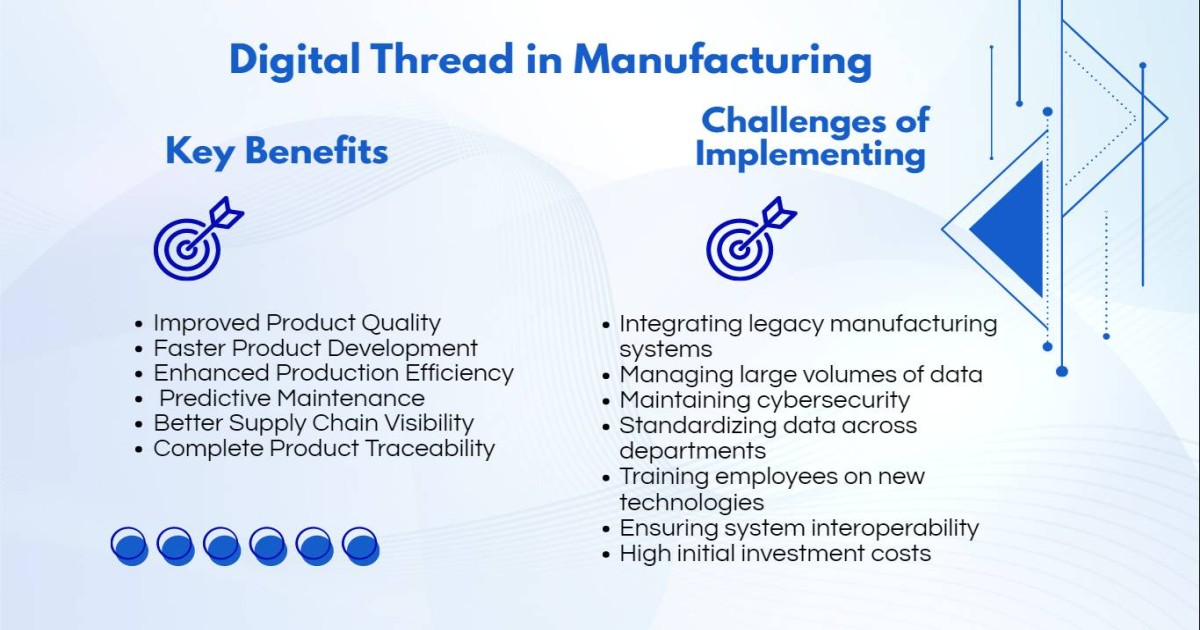
Key Benefits of Digital Thread in Manufacturing
1. Improved Product Quality
With complete visibility of production data, manufacturers can quickly identify defects, determine root causes, and implement corrective actions before problems become widespread.
Continuous monitoring helps reduce scrap, rework, and warranty claims while improving customer satisfaction.
2. Faster Product Development
Engineering teams can connect data more effectively when all the gathered data automatically flow through this production system.
This reduces human errors that shorten the development process and time.
3. Enhanced Production Efficiency
All connected production data enables manufacturers or engineers to monitor product performance at the real time.
Production managers can quickly identify the reasons those can stop or slow down the manufacturing process. They optimize workflows and try to make better resource utilization.
The result is increased productivity and lower operating time and costs.
4. Predictive Maintenance
IoT sensors continuously collect production data such as vibration, operating hours, pressure, and temperature.
Using predictive analytics, manufacturers can identify early warning signs of equipment failure before breakdowns occur.
Predictive maintenance reduces unexpected downtime, lowers repair costs, and extends equipment lifespan.
5. Better Supply Chain Visibility
A Digital Thread connects raw data or supplier information like inventory levels, production schedules, and logistics data into one platform so that all engineers can smoothly work together.
Manufacturers can respond faster without any disruptions and create optimized inventory management.
6. Complete Product Traceability
Every component and their manufacturing steps till maintenance record becomes part of the Digital Thread that does better the inspection result.
Complete traceability enables easier audits of products.
How Digital Thread Works
A Digital Thread continuously collects information from multiple sources and shares into different levels of manufacturing.
The process generally includes:
Engineering Validation
Design specifications, materials, simulations, and testing results are stored in Product Lifecycle Management systems.
Production Planning
Manufacturing Execution Systems generate production schedules, work instructions, and process parameters.
Smart Manufacturing
IoT-enabled products continuously share operational data during production.
Quality Inspection
Inspection systems identify quality issues in real time.
Maintenance
Equipment monitoring the systems that collect sensor data for predict any requirement of maintenance.
Customer Feedback
The performance information of the delivered product from clients in the field helps to improve better product designs in future.
This continuous flow of information makes a full digital history of every product.
Digital Thread and Industry 4.0
Industry 4.0 focuses on creating intelligent and connected manufacturing environments to simplify the process.
The Digital Thread acts as the foundation of Industry 4.0 by integrating advanced technologies such as:
- Artificial Intelligence (AI)
- Cloud Computing
- Machine Learning
- Internet of Things (IoT)
- Robotics
- Digital Twins
- Advanced Analytics
Together, these technologies enable engineers to build self-monitoring production systems that capable of continuous progress.
Real-World Applications
Digital Thread technology is transforming manufacturing across multiple industries.
Automotive Manufacturing
Automotive companies use Digital Threads to connect vehicle design, assembly lines, supplier networks, and quality inspections.
This improves production efficiency while ensuring consistent quality.
Aerospace
Aircraft manufacturers require complete traceability for every component.
Digital Threads provide detailed records throughout the product lifecycle, helping organizations meet strict regulatory standards.
Electronics Manufacturing
Electronics manufacturers use Digital Threads to monitor complex production processes, reduce defects, and accelerate new product development.
Medical Device Manufacturing
Medical device companies rely on Digital Threads to maintain regulatory compliance, improve quality control, and document every manufacturing step.
Challenges of Implementing Digital Thread
Although Digital Thread offers significant benefits, implementation requires careful planning.
Common challenges include:
- Integrating legacy manufacturing systems
- Managing large volumes of data
- Maintaining cybersecurity
- Standardizing data across departments
- Training employees on new technologies
- Ensuring system interoperability
- High initial investment costs
Organizations should develop a phased implementation strategy to minimize disruption.
Best Practices for Successful Digital Thread Adoption
Manufacturers can maximize success by following these best practices:
- Develop a clear digital transformation roadmap.
- Integrate ERP, MES, PLM, and IoT systems.
- Ensure high-quality, standardized data.
- Invest in scalable cloud infrastructure.
- Strengthen cybersecurity and data governance.
- Use predictive analytics to support decision-making.
- Train employees in digital technologies.
- Continuously monitor and optimize processes.
A strong implementation strategy ensures long-term value and sustainable growth.
The Future of Digital Thread in Manufacturing
The future of manufacturing lies in intelligent, autonomous operations.
As Artificial Intelligence becomes more advanced, Digital Threads will provide the real-time data required for AI-driven decision-making.
Manufacturers will increasingly combine Digital Thread with:
- Agentic AI
- Digital Twins
- Autonomous Robots
- Predictive Analytics
- Smart Supply Chains
- Sustainable Manufacturing
- Real-Time Process Optimization
These innovations will enable factories to become more adaptive, efficient, and resilient.
Conclusion
Digital Thread is reshaping manufacturing by connecting data across the entire product lifecycle. By integrating design, production, quality, maintenance, and supply chain information, manufacturers gain greater visibility, improve collaboration, and make faster, data-driven decisions.
Organizations that embrace Digital Thread technology can enhance product quality, reduce downtime, optimize operations, and prepare for the future of smart manufacturing. As Industry 4.0 evolves into increasingly intelligent and autonomous production environments, the Digital Thread will remain a critical foundation for innovation, competitiveness, and sustainable growth.
0 Comments